Updated
Copy trading is a well-established concept in the global financial markets, supporting a large and rapidly expanding marketplace projected to reach a valuation of $3.77 billion by 2028 [1].
But what is copy trading? At its core, copy trading is a form of communal investing that allows you to replicate another trader’s trades automatically. In recent years, it has become a popular tool for earning commissions and a simple way to diversify your portfolio.
Who participates in Copy Trading?
There are two main roles in copy trading: signal providers and copiers.
Signal providers are traders who publicly share their portfolios for others to copy, and in return earn from profit shares. Their main task is to develop attractive strategies that align with a copier’s trading style, taking into account factors such as risk tolerance, product interest, capital, and more. Copiers are traders who mirror a signal provider’s real-time trades.
For them, copy trading is a convenient way to participate in the markets without actively being involved or making trading decisions. They can copy multiple signal providers simultaneously, creating a fully diversified portfolio. Both participants benefit from each other, creating a community of like-minded investors keen to keep the markets rolling.
This method leverages the expertise of experienced traders, enabling even those with limited financial market knowledge to participate in trading. By mirroring seasoned professionals’ trades, beginners can achieve similar returns while learning trading strategies and market behaviour in real time. The rise of digital trading platforms and social trading networks has made copy trading more accessible than ever, providing a user-friendly entry point for those asking how to learn copy trading.
In this beginner-friendly guide, we’ll explain how copy trading works, how you can get started, and whether copy trading is profitable for new traders.
Introduction to Copy Trading for Beginners
Copy trading is an innovative approach to trading that allows beginners and experienced traders alike to benefit from sharing knowledge and expertise. By definition, copy trading automatically replicates the trades of a selected trader on a trading platform. When a trader is assigned to copy, their positions are duplicated in the copier’s trading account. Each subsequent trade executed by the trader is replicated in the copier’s account via an automated process.
As the popularity of copy trading grows, it has become a sought-after tool for beginners, allowing them to benefit from more experienced traders and their insights. This can help them gain a better understanding of the market and develop their own trading strategies.
Copy Trading vs Manual Trading
Manual Trading and Copy Trading differ in complexity and trader involvement.
With Manual Trading, it’s you against the markets, and your profits and losses are solely your own.
On the other hand, Copy Trading fosters collaboration between Signal Providers and Copiers to navigate markets and mutually benefit from potentially profitable strategies.
Is Copy Trading suitable for me?
Copy Trading is suitable for any trader at all levels of expertise.
The role you choose depends on what you aim to achieve through Copy Trading.
If you are:
- New to the financial markets
- Looking to participate in the markets, but do not have the time
- Wanting to trade a particular market session, but it’s always closed when you’re awake
- Wishing to avoid monitoring price movements all day
- Prone to making emotionally driven decisions
- Not sure how to build a strategy
- Looking for ways to diversify your portfolio
- Preferring someone else to handle your trades for you
Then you would be a suitable fit for the role of a Copier.
If you are:
- An experienced trader
- Looking for new avenues to earn more profits
- Building a profile as an analyst or investor
- Building a community of followers
- Earnest in encouraging others to participate in the markets
- Familiar with portfolio-building and trading strategies
Then you would make a fantastic Signal Provider.
Benefits and Limitations of Copy Trading
Copy Trading is undoubtedly one of the most significant steps toward financial accessibility.
New and experienced traders can benefit from copying positions, engaging in interactive discussions, and sharing strategies. However, Copy Trading is not without its flaws.
Benefits of Copy Trading
#1 Diversification
The rule of thumb in trading is to spread your capital across a few instruments to diversify your portfolio. In Copy Trading, your portfolio is multi-layered: Signal Providers have diversified portfolios, and by copying multiple Signal Providers, you would have layer upon layer of diversification.
#2 Time-Saving
Constantly monitoring price movements is a thing of the past. With Copy Trading, you can save months of research and learning by replying to the expertise of experienced traders. Plus, Copy Trading eliminates the need for an expensive fund manager by leveraging the collective wisdom of the crowd.
#3 Accessibility
Copy Trading enables retail investors and new traders alike to access the financial markets with ease and confidence, expanding accessibility. Even experienced traders who want to enter a new market can copy a Signal Provider first for a taste before diving headlong.
Opportunity to learn from Professional Traders
Copy Trading allows you to observe and learn from more experienced, accomplished traders. By following lead traders with a proven track record, you can learn about their trading strategies and techniques, which can be beneficial in developing your own trading skills.
Limitations
#1 Experience
Copy Trading has been praised for its ability to act as a quick pass to trading, but its most significant flaw lies therein. It comes with the expense of experience. Copiers’ reliance on their Signal Providers undermines the need for financial literacy to navigate the markets independently. This jeopardises their capital, as they lack the knowledge and emotional maturity to develop a risk management plan.
#2 Control
Entrusting your funds to a Signal Provider does not guarantee a return. Though you control exposure through lots and margins via Copy Mode, your success still depends on the original strategy set by the Signal Provider. The balance between optimism and caution is something every trader, even a Copier, must make.
Copy Trade with Vantage
We have recently launched an updated version of our Copy Trading system on 2 April 2023. The new App-based system offers a range of features and improvements that traders of all experience levels will appreciate. Vantage has re-engineered the app to ensure enhanced stability and faster execution speeds than ever before. Additionally, the Copy Trading section has undergone a complete overhaul and now offers a much more user-friendly experience, with a comprehensive array of information.
How Does Vantage’s Copy Trading Work?
Now that you are aware of the two roles involved in Vantage Copy Trading, let’s explain how Copy Trading works. Using Vantage’s Copy Trading function, Copiers can mirror the trading activities of the Signal Providers they choose. For instance, if the chosen Signal Provider is trading 1 lot of Apple stock on a given day, that trade will be reflected in the Copier’s Copy Trading account. This is essentially how Copy Trading works.
By utilising the Copy Trading function, Copiers can gain first-hand trading experience in a diverse range of products across various markets, such as shares, commodities, indices, forex, and cryptocurrencies, without solely relying on extensive market research or analysis. This powerful function allows novice Copiers to reap the benefits of trading without the burden of manually identifying products.
Moreover, a broad selection of Signal Providers is available through Vantage Copy Trading, ensuring that Copiers can find Signal Providers whose trading style resonates with them. Copiers can learn from the best and build on their Signal Providers’ knowledge and experience. Vantage Copy Trading is also helpful for those who have limited time to monitor the markets daily. By copying a Signal Provider, traders can continue executing trades without actively monitoring them.
Copy Trading Strategies
Copy trading is not just about following a single top-performing trader. To use it effectively, you need a structured strategy for capital allocation, provider selection, and risk management. The following approaches can help you think more strategically as a Copier.
1. Capital Allocation Strategies
a. Equal Distribution Approach
Instead of placing all your funds with one trader, you can distribute your capital evenly across several Signal Providers. This approach is straightforward and reduces the risk of overreliance on any single strategy.
However, the effectiveness of this method depends on the diversity of the traders chosen. For optimal results, select providers with diverse market focus and trading styles to minimize position overlap.
b. Performance-Risk Weighting
This method adjusts your allocation based on each trader’s historical performance and risk behavior. Providers who demonstrate consistent results with moderate risk receive a larger share of your capital, while more volatile or aggressive traders are assigned smaller portions.
You might apply a cap (e.g., no more than 10% per high-risk provider) to help control potential losses from sudden drawdowns.
c. Objective-Oriented Allocation
Divide your capital in alignment with your financial goals:
- A significant portion could be directed toward steady, lower-risk traders.
- A secondary share might support higher-growth strategies, accepting some volatility.
- A small percentage could be reserved for testing new providers before committing more capital.
2. Diversification Strategies
Copy trading enables diversification across asset classes, trading styles, and personalities. A well-diversified copy trading portfolio can help balance risk and return.
Here’s how you can diversify effectively:
- By Provider: Follow traders using different methods; some rely on technical analysis, others on fundamental trends, or on specific market niches.
- By Market Exposure: Aim to include providers that focus on different asset classes (e.g., major currency pairs, commodities, indices, or crypto).
- By Strategy Duration: Blend short-term, swing, and long-term traders to adapt across different market environments and volatility levels.
3. Risk Management Strategies
Even though you’re following someone else’s trades, you remain responsible for the risk. Building protective measures into your strategy can make a significant difference over time.
Some key techniques include:
- Limit Exposure per Provider: Avoid assigning too much capital to any one Signal Provider. A guideline might be to limit exposure to 20%–25% per provider.
- Set Loss Thresholds: Determine in advance how much decline from a provider’s peak you’re willing to accept before scaling back or disconnecting.
- Adjust Copying Ratios: Use platform tools to manage trade sizes relative to the original provider. If your account is smaller, using a lower copy ratio may help manage volatility.
- Regular Check-ins: Evaluate your portfolio monthly or quarterly to ensure it remains aligned with your financial goals and risk tolerance
4. Time Horizon Strategies
Different traders operate on different timelines. Understanding their approaches helps you select those that match your own emotional tolerance and financial objectives:
- Intraday/Scalpers: High-frequency, short-holding trades. They require tighter execution and are more sensitive to costs, such as spreads.
- Swing Traders: Trades typically last a few days to a couple of weeks and focus on medium-term price movements.
- Position Traders: Long-term strategies based on broader macroeconomic themes or market cycles.
Beginners may prefer traders with a slower pace to make tracking easier and provide emotional comfort during drawdowns.
Step-by-Step Guide for Beginners
This beginner-oriented process provides structure as you start using copy trading responsibly. It’s not financial advice, but a general framework to help reduce common mistakes.
Step 1: Define Your Goals and Risk Tolerance
Start by identifying your primary motivation, whether it’s learning, diversifying, or earning supplemental returns. Know how much capital you can afford to put at risk, and clarify whether your priority is preservation, steady growth, or higher-risk gains.
Step 2: Learn the Basics of Trading and Leverage
Understand core trading concepts like margin, leverage, drawdowns, and spreads. Copying trades does not remove risk; it mirrors the performance of your chosen providers, often amplified by leverage.
Step 3: Select a Copy Trading Platform
Choose a regulated platform that aligns with your region, supports your preferred assets, and provides transparency on provider performance, risk levels, and fees. Complete account setup steps (such as identity verification) and learn how fees apply specifically to copy trading.
Step 4: Explore and Shortlist Signal Providers
Use filters to identify providers based on historical return, risk metrics, and time in the market. Important factors include:
- Drawdown History
- Trading Frequency
- Risk Classification
- Consistency Across Market Conditions
- Popularity & Volume Copied (as a secondary reference)
Avoid judging providers solely by their recent returns.
Step 5: Practise in Demo Mode (If Available)
If your platform offers it, copy providers in a demo account first. Observe how trades replicate, the delay involved, and how your equity fluctuates over time. Experiment with different allocation sizes.
Step 6: Begin with a Small Allocation
Once you’re confident, fund your account with an amount you’re comfortable risking. Start with small allocations to each provider and set limits for:
- Maximum per provider
- Maximum total exposure
- Account-level drawdown limits
Step 7: Monitor and Review Periodically
Track your copy trading performance weekly or monthly, not daily. Look for significant changes in a provider’s trading behavior, risk levels, or consistency. Be prepared to reallocate if your strategy or the provider’s risk profile changes.
Step 8: Build Knowledge Over Time
Use copy trading as a learning opportunity. Review the logic behind provider trades and develop your own understanding of strategy and risk management. Over time, you may blend manual trading with copy trading to form a hybrid approach.
Copy Trading vs Manual/Traditional Trading
While both approaches grant access to global financial markets, they differ significantly in how trades are made and managed.
| Aspect | Copy Trading | Manual Trading |
| Decision-Making | Trades are mirrored from selected providers. | You independently analyze and execute all trades. |
| Time Involvement | Lower – primarily focused on monitoring and adjusting allocations. | High – involves regular analysis and manual execution. |
| Experience Needed | Suitable for beginners; some market understanding is still required. | Requires a deeper understanding of markets, tools, and trading psychology. |
| Trade Control | Limited to selecting providers and capital allocation. | Complete control over all aspects of each trade. |
| Learning Curve | Learn passively by observing providers’ strategies and outcomes. | Those with limited time or seeking a quick overview of different strategies. |
| Emotional Management | May reduce overtrading, but emotional response to loss still matters. | Greater emotional involvement requires discipline to be critical. |
| Best For | Those with less time or looking for quick exposure to different strategies. | Those who prefer autonomy and are building a custom trading system. |
Risks in Copy Trading and How to Manage Them
Copy trading does not eliminate risk; it reshapes it. Awareness and proactive management are essential.
1. Market Risk
What it is: All trading involves exposure to market movements. Even experienced providers will face periods of loss.
How to manage:
- Never invest funds you can’t afford to lose.
- Limit leverage where possible.
- Diversify across instruments and providers.
2. Signal Provider Risk
What it is: Providers can change behavior or incur unexpected losses.
How to manage:
- Focus on long-term stability rather than short-term gains.
- Monitor shifts in drawdown or trade frequency.
- Set personal limits for removing or reducing exposure.
3. Concentration Risk
What it is: Allocating too much to a single provider, or similar strategies, increases vulnerability.
How to manage:
- Use caps on allocation per provider.
- Diversify by asset, time horizon, and strategy.
- Check for overlapping trades across your chosen providers.
4. Execution Risk
What it is: Copy delays or platform disruptions can affect trade outcomes.
How to manage:
- Choose reputable platforms with proven uptime.
- Keep your software updated.
- Avoid trading during scheduled maintenance periods.
5. Liquidity Risk
What it is: Large combined orders from many copiers can increase slippage, especially in thin markets.
How to manage:
- Prefer providers who trade in highly liquid assets.
- Avoid copying traders who use huge order sizes in niche markets.
6. Emotional and Behavioral Risk
What it is: Emotional reactions can lead to poor decisions, e.g., chasing recent winners or panicking during drawdowns.
How to manage:
- Develop written rules for selecting providers and establishing exit criteria.
- Set review intervals (e.g., monthly) to avoid reactionary decisions.
- Recognize that drawdowns are part of any strategy, even successful ones.
3 Tips to Get Started with Copy Trading
For beginners, here are three things to consider before getting started on Copy Trading:
Diversify by copying multiple Signal Providers.
Diversification is just as important to Copy Trading as it is to conventional trading. You should avoid placing all your eggs in one basket by following a single trader. Instead, you may allocate your trades across multiple traders with different trading styles, strategies, and asset allocations. It is advisable to carefully consider each trader’s historical performance, risk tolerance, and trading strategy before entrusting your funds to them. Having a well-rounded, diversified Copy Trading portfolio can help mitigate the risk of exposing your entire capital to a single Signal Provider.
Monitor and adjust your strategy.
Copy Trading may seem more passive than conventional trading, but it still requires regular monitoring and adjustments to your portfolio. Monitor the performance of the traders you are copying from and be prepared to make adjustments if necessary. Stay informed about the market conditions, as they can significantly impact your copied trades. If a trader’s performance begins to decline or if their trading strategy no longer aligns with your trading goals, you should not hesitate to stop following them and seek out a more suitable trader.
Choose the right platform and trader.
Your Copy Trading experience is heavily influenced by the platform you choose and the traders you decide to follow. You are encouraged to select a reputable Copy Trading platform that offers high user-friendliness, robust security, and a diverse selection of experienced traders. Besides, you may pay close attention to the platform’s fee structure and user reviews before making your decision to start Copy Trading. After selecting a platform, it is crucial to evaluate the available traders you can copy from, based on factors such as trading style, historical performance, and risk tolerance, to identify those who align with your trading goals.
What is New with Vantage Copy Trading?
The Vantage Copy Trading App user interface (UI) has been enhanced and redesigned. Under the Community tab, more comprehensive filters have been added. This will enable Copiers to find suitable Signal Providers that meet their requirements easily.
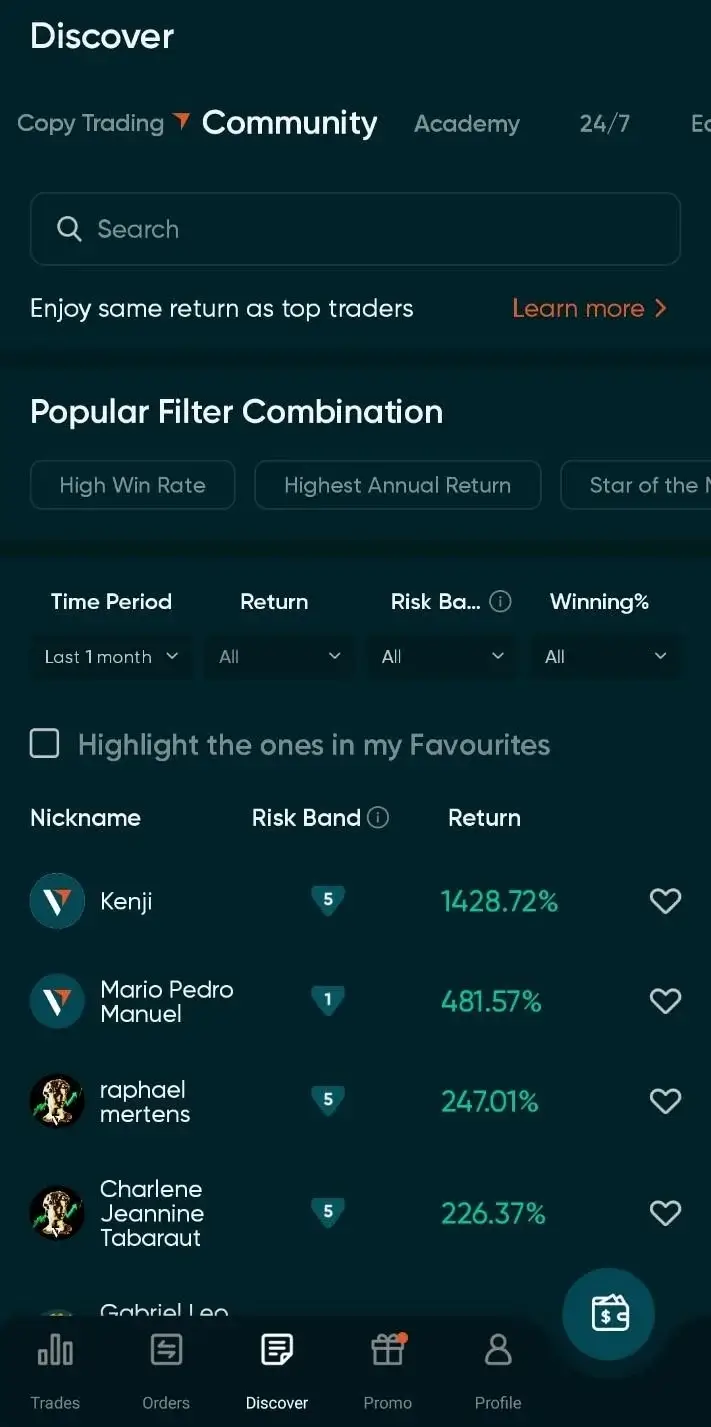
Copiers are able to filter the Signal Providers according to:
- Time period: This refers to the duration for which the results of trades are being measured. For example, if the time period is one month, the trades made during that month will be evaluated.
- Return: This is the percentage of return that a trader can estimate to earn when they make a trade. For instance, if the return is 10%, then for every $100 traded, the trader can expect to earn $10. However, it’s important to note that past performance is not indicative of future results. The percentage of return indicated here is merely for reference and should not be taken as absolute certainty.
- Risk Band: A measure of a trader’s volatility. A higher risk band indicates that the trader assumes greater risk when trading. This is usually determined by factors such as the trader’s trading strategy and the assets being traded.
- Winning Percentage: This is the percentage of trades that the trader wins over a given period. For example, if a trader wins 70% of their trades, it means that out of every 10 trades made, they win 7 and lose 3. The winning percentage can be used to evaluate the trader’s success rate.
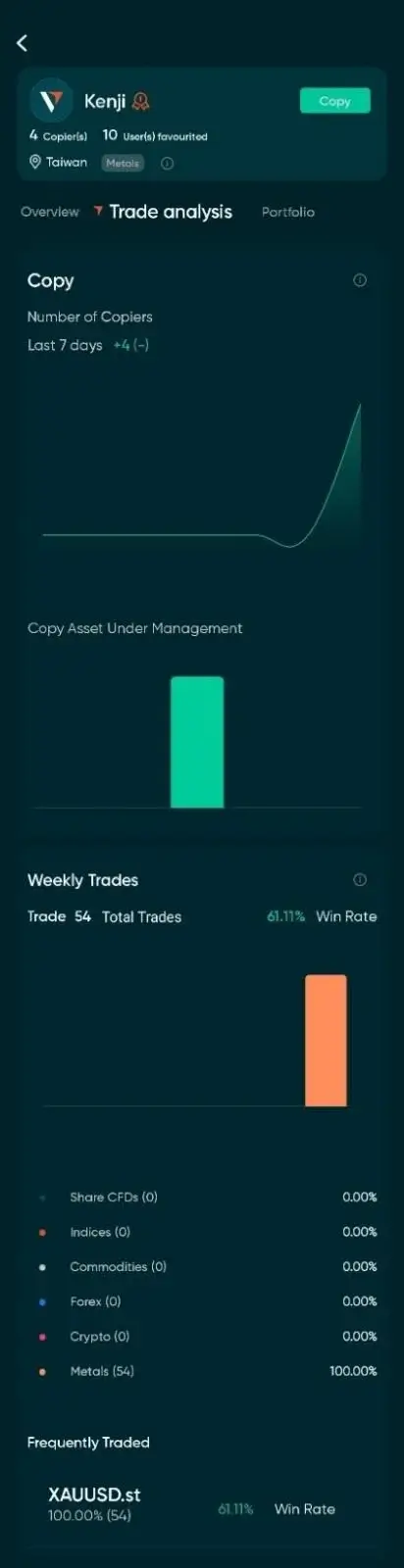
The Signal Providers’ profiles have been improved and redesigned with personalised cards and an enhanced display of basic information. This makes it easier for users to analyse Signal Providers’ details and determine whether to follow their trades. Additionally, the monthly return and risk band overview provides Copiers with valuable information on the Signal Providers’ trading performance over time, including profitability and risk.

By browsing the Signal Provider’s profile, Copiers can also see how many users have replicated their trades in the last 7 days and access information on the Signal Provider’s most frequently traded products. This information can help Copiers make informed decisions when selecting a Signal Provider. By gaining insight into the popularity and performance of the Signal Provider’s trading strategy, Copiers can determine whether it aligns with their investment goals and risk tolerance.
Ready to take your trading experience to the next level? Discover the benefits of Copy Trading with the Vantage App! Download the app here!
Why use Copy Trading with Vantage?
The Copy Trading function on the Vantage App offers several benefits that can help Copiers achieve their trading goals:
Accessibility
Copy Trading provides an accessible route to trading. Many Copy Trading platforms now offer user-friendly interfaces and educational resources to help beginners get started. By providing an accessible entry point into trading, Copy Trading enables novice traders to trade alongside experts with greater confidence.
Upskill your trading knowledge.
Copy Trading enables Copiers to follow and replicate the trades of experienced traders, allowing them to learn from successful strategies and develop their own skills. By observing the trades successful traders make, the methods they use, and the market conditions under which they operate, Copiers can gain valuable insights and deepen their trading knowledge.
Time-saving
Copy Trading can be a time-saving solution. By following experienced traders’ trades, Copiers can benefit from their expertise and knowledge without conducting extensive research and analysis themselves. This is particularly useful for those who do not have the time to monitor the market daily but still desire to trade.
Choose Copy Trading with Vantage
Copy trading can be a valuable tool for beginners looking to learn from experienced traders and potentially mimic their returns. Ready to utilise the copy trading function to help with your trades?
If you’re looking for a copy trading platform that offers a user-friendly experience, an easy-to-use system, and a wide range of assets, Vantage is a great choice. With award-winning 24/7 customer service and an intuitive user interface, the Vantage App allows you to trade efficiently and seamlessly. You can even connect your MT4/MT5 account to take your trading adventures on the road. The app provides a comprehensive display of signal providers, including their track records and invested assets, all available at your fingertips.
So, download the Vantage App today, learn what copy trading is, and start from as low as $50! Find out more about Vantage copy trading here.
Frequently Asked Questions
What is Copy trading?
Copy trading is an investment method that allows you to automatically replicate the trades of experienced traders. Your account mirrors their positions in real time, making it easier for beginners to participate in the markets without needing advanced analysis or trading skills.
How does copy trading work?
Copy trading works by selecting a skilled trader whose strategy you want to follow. Once you copy them, every trade they open or close is automatically mirrored in your account, based on your chosen risk settings and capital allocation.
Is copy trading profitable?
Copy trading can be profitable, but results depend on the trader you copy, your risk settings, and market conditions. It offers the potential for steady gains but also carries the same risks as traditional trading, so careful selection is essential.
How do you learn copy trading?
You can learn copy trading by understanding basic trading concepts, analysing signal provider performance, practising on demo accounts, and starting with small allocations. Observing experienced traders’ strategies helps build knowledge while reducing the learning curve for beginners.
Is copy trading safe for beginners?
Copy trading can be safe for beginners when using reputable platforms, diversifying across multiple traders, and applying controlled risk settings. While it simplifies decisions, it still involves market risk, so monitoring performance and learning gradually is essential.
Reference:
- “Is Copy Trading A Viable Way To Invest? – Finance Monthly”. https://www.finance-monthly.com/2023/02/is-copy-trading-a-viable-way-to-invest/. Accessed 10 April 2023.